

The Role Meta Ads Should Play at Each Stage of Your Customer Journey
Disclosure: This post contains affiliate links. If you purchase through my link I may earn a small commission at no additional cost to you. I only recommend tools and resources I genuinely use and believe in.
One of the most common misconceptions I think people have about Meta Ads is that they’re just something you turn on when you have something to sell and turn off when you don’t. However, ads can serve a completely different and equally important purpose depending on where someone is in their relationship with your business
I like to say that ads can act as an employee of sorts, depending on how you choose to set them up and put them to work for your business.
That’s not something most people realize so I want to show you what this could look like across your entire customer journey so you can see how many benefits you may be leaving on the table.
Before We Talk Ads, Let's Talk About How People Actually Buy
A customer journey isn’t a complicated thing. It’s just the steps that people go through as they move through the different stages of their interactions with your business. You may have heard of this comparison before but you wouldn’t walk up to a stranger on the street and immediately ask them to marry you. But some of you who sell things online are doing something similar when you only run ads to a completely cold audience, asking those people to buy from you.
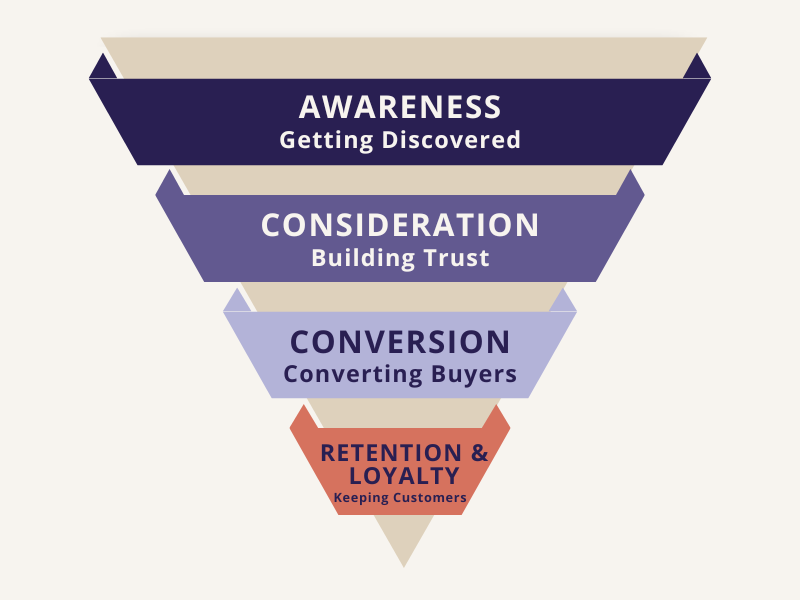
There are stages to the customer journey but thankfully there aren’t too many so it’s pretty simple. Some people say there are 4 stages. Others say 5 or more. We’ll work with just 4 here and I’m combining two into the fourth one but you’ll see why when I tie it to ads.
Awareness
Consideration
Conversion
Retention & Loyalty
Most businesses only use ads at stage 3, the Conversion stage and because of that, they’re missing an enormous opportunity at every other stage. So as we go through the stages, I’m going to frame this in terms of ads and how they would apply to that stage.
Stage One: Awareness - Getting Discovered by the Right People
Engagement ads introduce you to people who have never heard of you. When thinking of this in terms of a sales funnel, this is the top of the funnel. The goal is not to sell. It’s to get in front of the right people and make a strong first impression.
These types of ads are great for:
Targeting new cold audiences
Testing different cold audiences against broad targeting
Testing messaging angles and hooks
Building brand awareness
Consistently growing your warm audience and following for later ad retargeting
Spending a small budget but getting a huge impact (people can start at just $1 a day with these)
Pushing your organic social post content out to not just more people but the people who you actually would like to reach
Repurposing other types of content, like podcast episodes and YouTube videos
Building your authority as an expert
And bonus - run content to your warm audience to keep you at the top of their mind and increase your touchpoints with them to keep them nurtured
This stage matters especially when you’re not launching because every person who enters your awareness stage today is a potential warm audience member for your next launch. And you even use this stage to continually nurture the already warm audience right on the platform where they will get used to seeing you over and over again. The bigger and warmer that pool is, the better your launch results will be.
Building out a simple engagement ad strategy for each and every one of my clients is a critical component of my Momentum Framework, which I talked about more in this post.
Stage Two: Consideration - Turning Strangers Into Warm Leads
In the Consideration phase, you have a lot of options. This is the stage where someone is warm to you, and I think of that warmth as a spectrum. Maybe they just started seeing your ads and content so they are just semi-warm. To go back to the dating example, this is when you just saw that person and started making eyes at each other. At that point, you start engaging with their content (first date time!) and get a little warmer.
Or they have been engaging on your ads and content for a while and now they are so warm that they’re almost to the next stage of Conversion. In the dating example, depending on who you are, you’d consider this the stage where you’re meeting each other’s friends and family and if you’re really comfortable with them after a while, you may be ready for a bigger commitment.
The important thing to remember at this second stage is that this is where most of the nurturing work happens. Ads at this stage take people who have seen you and give them a reason to go deeper. This is where you start building real relationships and trust.
These types of ads are great for:
Continuing the engagement ads from stage 1 but targeting people who have interacted with them so you keep them engaged
More content promotion ads driving people to your best blog posts or podcast episodes
In this level of engagement ad, you can talk about your varied areas of expertise and the aspects of how you help people
Running Lead ads for building your email list by offering a free lead magnet (like my Meta Ads Gap Finder) or an invitation to a webinar
This stage is where most of the long-term value lives. An email subscriber or someone who has consumed multiple pieces of your content is dramatically more likely to buy in the next stage than a cold stranger would.
And I always encourage every business owner to be building an email list, regardless of how long they’ve been in business. It’s a subject for a lengthier post but I’ll say this - if you’re only building a following on social media, if you get hacked or lose access to your accounts, you will lose access to that audience. I’ve seen this happen again and again. It happened to my first ad client and it was painful to watch.
An email list gives you a way to reach your audience at any time. Think of it like building your own community. It’s a great place to nurture them so if you haven’t started doing that yet, I urge you to begin building your list as soon as possible.
If you’re holding off because you don’t even know how to start or what to talk about, then I’ll recommend my favorite resource for starting your email list, which is Liz Wilcox’s Email Marketing Membership. Full disclosure, I'm an affiliate for this so I may earn a commission if you join through my link, but I genuinely use and love it. It’s how I started my list and I couldn’t have done it without joining this membership.
You get a simple email template every week that you can either use as a fill-in-the-blanks kind of thing or simply take the main idea and run with it on your own. I don’t know about you but sometimes I’m out of ideas so having someone else do that thinking for me is priceless. But the low cost of the membership makes it something that’s hard to pass up.
Stage Three: Conversion - Converting Warm Leads Into Buyers
Here are a few questions to ponder to see if you’re in need of a paid traffic strategy:
Am I only running ads for launches and not in between (either for email list building or just brand awareness and audience growth - or both)?
Does my audience only hear from me when I have something to sell to them?
Does my ad account sit dormant for weeks or months at a time?
If the answer to these questions is all or mostly yes, then you’ve been running ads tactically and that's why your results feel inconsistent. That's fixable. But it requires a different approach than what you’ve been doing.
That different approach starts with having the right foundation in place before anything else. If you haven't already built your pre-ad foundation, start there first. I covered exactly what that looks like in this post.
When I work with my clients, we work together to design a full-funnel ad strategy following what I call The Momentum Framework. That involves running consistent ads between launches, using content my clients are already creating - just making it work smarter and harder for them with ads. Then we also layer in email list building ads. And finally, when they are launching, we run the usual conversion/sales ads.
It truly is the layered approach of my paid traffic strategy that creates the foundation for them to maintain momentum so they can grow larger and faster than they would with the start and stop tactical approach. And keep in mind that this does not necessarily mean spending more. It’s more about spending smart to get the maximum benefit out of the budget.
Stage Four: Retention & Loyalty - Keeping Buyers Engaged and Coming Back
This is also a stage that almost nobody talks about in the context of ads but they keep existing customers engaged, introduce them to your other offers, and turn one-time buyers into repeat customers or higher ticket clients.
Examples of ads in the Retention & Loyalty stage:
Promotion of a new offer to your existing audience
Upsell ads to people who bought a lower-ticket product
Downsell ads to people who didn’t buy your higher-ticket product
Community or membership ads targeted to past buyers
Your existing buyers are your warmest possible audience. They’re the ones who know, like, and trust you the most. They’ve been in your world and love what you’re doing. They’ll show up loving on and commenting on your ads when they see them to tell people just how much they love what you’re selling. That’s great social proof. Using ads to stay in front of your existing audience is one of the highest ROI moves available to any online business owner.
What this Means for How You Allocate Your Ad Budget
When you see ads as serving four distinct purposes across a customer journey rather than just focusing only on the conversion stage, your entire relationship with your ad budget changes.
You stop thinking about ads as a cost you’ll have during a launch and start thinking about them as a growth investment that runs continuously at different levels depending on where you are in your business calendar.
This doesn't mean spending more. It means spending smarter and more intentionally across all four stages rather than dumping everything into conversion ads and wondering why results are expensive and inconsistent.
Ready to Build an Ad Strategy That Works at Every Stage?
The businesses that get the most out of Meta ads aren't just running better ads than you are and they aren’t necessarily spending a whole lot more. They're using ads more strategically across the full customer journey. That's a completely learnable and buildable skill.
If you want to map out exactly how ads should fit into your customer journey and where the biggest opportunities are in your specific business, that's exactly what we dig into in The Ads & Funnel Clarity Session.
Not sure where to start? Grab the free Meta Ads Gap Finder and get clarity on your foundation first.


