
How to Build a Meta Ads Funnel That Works With Your Existing Content
If you've been creating content for your business for any length of time, you probably already know the drill. You post consistently, you show up on Instagram, maybe you have a podcast or a YouTube channel, and somewhere along the way you hired a social media strategist to help you stay on top of the never-ending cycle of content creation and posting. You know that showing up with content is non-negotiable. Without it, your visibility suffers and in turn, your business suffers.
What most established coaches and course creators haven't been told is that the content they're already creating is also the ideal raw material for a complete Meta ads funnel. Not a separate ads content strategy and not a new library of creative to build from scratch. The posts, reels, podcast clips, and videos that have already been created is what makes up the funnel. It just needs structure, strategy, and a small budget behind it to work the way it's supposed to.
That's what I want to show you here.
Why Most Established Coaches Prioritize Organic Over Paid, And What That's Costing Them
Here's a pattern I've seen play out countless times with established online business owners. They hire a social media strategist long before they ever think about hiring a Meta ads strategist. And that makes complete sense. They understand instinctively that consistent content is the foundation of their visibility. They've built their authority through years of showing up and they know what happens if they go quiet.
What they haven't fully connected yet is that all of that content they're paying a team to create and post is largely subject to whatever the algorithm decides to do with it on any given day. Some posts land. Some disappear. Reach fluctuates. And the carefully crafted content that took hours to produce gets shown to a fraction of the audience it deserves.
Organic and paid aren't competing strategies. They were always meant to work together. The content business owners have been creating for organic is also the exact raw material for a paid strategy that puts them in control of who sees it, when they see it, and in what order. They just haven't been using it that way yet.
What a Meta Ads Funnel Actually Is And Why It's Not What You Think
A Meta ads funnel is not a complicated technical structure. It's a strategic sequence of content that moves people through stages of awareness, consideration, and conversion using paid promotion. Think of it as a curated journey you design for your ideal client. It's one where you decide what they see first, what comes next, and what they see when they're warm enough to receive an offer.
This is fundamentally different from running one ad to a cold audience and hoping they buy. Most people who try ads and feel like they don't work have been doing exactly that. Jumping straight to conversion content with people who have never heard of them.
A Meta ads funnel changes the entire dynamic because it mirrors how people actually make buying decisions. They discover you, they learn from you, they begin to trust you, and then they buy from you. The funnel just makes that journey intentional rather than accidental.
If you've read my post on the customer journey stages, you already have the framework for understanding how this works. The funnel maps directly onto those stages.
You Already Have Everything You Need - Here's How to See It Differently
Here's what I want you to consider. If you've been creating content for a few years, you have a library. Posts, reels, videos, podcast episodes, testimonials, client wins, educational content, personal stories. That library contains every piece of content you need to build a complete Meta ads funnel right now.
The problem isn't a content gap. It's that all of that content has been living in your feed doing whatever the algorithm decides to do with it, rather than being placed strategically in front of the right people at the right stage of their relationship with your business.
Here's something that surprises most established content creators when they first hear it. Building a Meta ads funnel around your existing content could actually allow you to post less organically. When your ads are handling the consistent visibility and discovery work of reaching new audiences, nurturing engaged followers, staying top of mind, you don't have to post every day or multiple times a day to maintain presence. You could bring your organic cadence down to a few times a week, or focus primarily on stories and connection content, and let your ads do the reach and discovery work. That's the kind of leverage that allows you to do less work.
Think of it this way. If you have team members helping you run your business, you already understand that good people don't come cheap and the right support is worth every dollar. A well-built Meta ads funnel works the same way. It's a strategic asset running consistently in the background, reaching the right people at the right time, working while you sleep.
Content Mapping: How to Match Your Existing Content to Your Funnel Stages
This is the part that changes everything for most content creators when they see it. It's called content mapping and it's exactly what it sounds like. It's going through your existing content library and assigning each piece to the funnel stage it's best suited for.
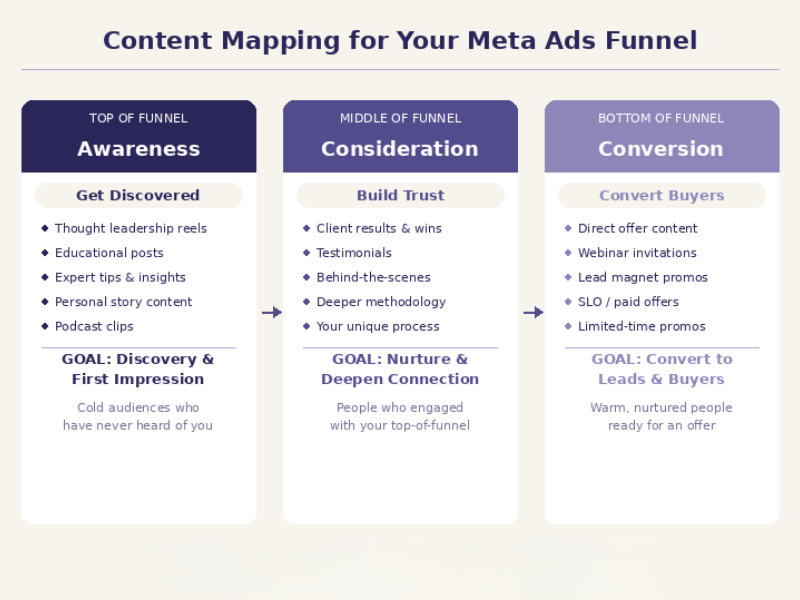
Top of Funnel: Awareness Content. This is your thought leadership. Your educational reels and posts that demonstrate your expertise and point of view. Your personal story content that builds connection. Existing Instagram and Facebook posts, podcast clips, YouTube video clips, and blog posts all belong here too. The goal at this stage is discovery and first impression, not selling. This content goes in front of new cold audiences who have never heard of you. You're not asking them to do anything except notice you and find you interesting.
Middle of Funnel: Consideration Content. This is your trust-building and nurture content. Client results and transformation stories. Testimonials. Behind-the-scenes content that shows your process and your personality. Deeper educational content and podcast or YouTube clips that demonstrate your methodology. This is also the stage where list building lives. Free lead magnets and email opt-in promotions belong here, not at the bottom of the funnel. You're not asking for money yet. You're asking for trust. This goes in front of people who have already engaged with your top of funnel content. They know who you are, and now you're giving them reasons to go deeper. By the time someone has seen three or four pieces of your consideration content, they start feeling like they know you.
Bottom of Funnel: Conversion Content. This is your direct offer content. Webinar or challenge invitations. Self-liquidating offer (SLO) or paid offers. Cart open and cart close ads during a launch. Sales page ads and limited-time promotions. This goes only in front of people who have already moved through the earlier stages - people who have engaged with your awareness content, consumed your consideration content, and are warm enough to be genuinely receptive to an offer. Because they've been nurtured through the funnel, they convert at a much higher rate and a much lower cost than any cold audience would.
What you're doing when you build this funnel is curating what people see and when. Rather than leaving it to the algorithm to serve your best content to whoever it decides to show it to, you're designing the sequence intentionally. You're making sure that by the time someone sees an offer from you, they already know who you are, trust what you do, and have context for why your offer is relevant to them.
This content mapping approach is the practical application of the full-funnel strategy I laid out in this post. If you haven't read that yet it will give you the bigger picture of why this approach compounds over time.
What Building This Funnel Actually Changes for Your Business
When you build a Meta ads funnel around your existing content, you'll notice a few things shift that'll make a huge difference in your life and business.
First, you stop being at the mercy of the algorithm. You decide who sees your best content and when.
Second, you stop launching to the same small pool of people every time and start launching into a warm audience that has been growing and nurturing in the background for weeks or months.
Third, your content starts working longer. An organic post has a lifespan of hours or maybe a few days before it disappears into the feed. A piece of content running as an ad keeps working, reaching new people, building your warm audience, compounding your visibility, for as long as you choose to run it.
That thought leadership piece you recorded six months ago that performed well? It could be reaching new ideal clients today. The testimonial video that got great engagement last year? It's still relevant and it's still building trust. A Meta ads funnel takes the content you've already invested in creating and extends its reach and lifespan indefinitely.
Your Content Already Works Well But We Can Make It Work Harder
You don't need to create more content. You don't need a separate ads strategy that runs parallel to everything you're already doing. You need a framework that takes what you've already built and puts it to work in a smarter, more intentional way. A system that compounds over time and gives you control over who discovers you, who gets nurtured, and who moves toward buying.
That's what a Meta ads funnel built on existing content does. The best part is you already have everything you need to build one. The next step is mapping your specific content to the right funnel stages for your business, and that's exactly what we do together in The Ads & Funnel Clarity Session.
Not sure if your foundation is ready for this yet? Start with the free Meta Ads Gap Finder.


How to Build a Meta Ads Funnel That Works With Your Existing Content
If you've been creating content for your business for any length of time, you probably already know the drill. You post consistently, you show up on Instagram, maybe you have a podcast or a YouTube channel, and somewhere along the way you hired a social media strategist to help you stay on top of the never-ending cycle of content creation and posting. You know that showing up with content is non-negotiable. Without it, your visibility suffers and in turn, your business suffers.
What most established coaches and course creators haven't been told is that the content they're already creating is also the ideal raw material for a complete Meta ads funnel. Not a separate ads content strategy and not a new library of creative to build from scratch. The posts, reels, podcast clips, and videos that have already been created is what makes up the funnel. It just needs structure, strategy, and a small budget behind it to work the way it's supposed to.
That's what I want to show you here.
Why Most Established Coaches Prioritize Organic Over Paid, And What That's Costing Them
Here's a pattern I've seen play out countless times with established online business owners. They hire a social media strategist long before they ever think about hiring a Meta ads strategist. And that makes complete sense. They understand instinctively that consistent content is the foundation of their visibility. They've built their authority through years of showing up and they know what happens if they go quiet.
What they haven't fully connected yet is that all of that content they're paying a team to create and post is largely subject to whatever the algorithm decides to do with it on any given day. Some posts land. Some disappear. Reach fluctuates. And the carefully crafted content that took hours to produce gets shown to a fraction of the audience it deserves.
Organic and paid aren't competing strategies. They were always meant to work together. The content business owners have been creating for organic is also the exact raw material for a paid strategy that puts them in control of who sees it, when they see it, and in what order. They just haven't been using it that way yet.
What a Meta Ads Funnel Actually Is And Why It's Not What You Think
A Meta ads funnel is not a complicated technical structure. It's a strategic sequence of content that moves people through stages of awareness, consideration, and conversion using paid promotion. Think of it as a curated journey you design for your ideal client. It's one where you decide what they see first, what comes next, and what they see when they're warm enough to receive an offer.
This is fundamentally different from running one ad to a cold audience and hoping they buy. Most people who try ads and feel like they don't work have been doing exactly that. Jumping straight to conversion content with people who have never heard of them.
A Meta ads funnel changes the entire dynamic because it mirrors how people actually make buying decisions. They discover you, they learn from you, they begin to trust you, and then they buy from you. The funnel just makes that journey intentional rather than accidental.
If you've read my post on the customer journey stages, you already have the framework for understanding how this works. The funnel maps directly onto those stages.
You Already Have Everything You Need - Here's How to See It Differently
Here's what I want you to consider. If you've been creating content for a few years, you have a library. Posts, reels, videos, podcast episodes, testimonials, client wins, educational content, personal stories. That library contains every piece of content you need to build a complete Meta ads funnel right now.
The problem isn't a content gap. It's that all of that content has been living in your feed doing whatever the algorithm decides to do with it, rather than being placed strategically in front of the right people at the right stage of their relationship with your business.
Here's something that surprises most established content creators when they first hear it. Building a Meta ads funnel around your existing content could actually allow you to post less organically. When your ads are handling the consistent visibility and discovery work of reaching new audiences, nurturing engaged followers, staying top of mind, you don't have to post every day or multiple times a day to maintain presence. You could bring your organic cadence down to a few times a week, or focus primarily on stories and connection content, and let your ads do the reach and discovery work. That's the kind of leverage that allows you to do less work.
Think of it this way. If you have team members helping you run your business, you already understand that good people don't come cheap and the right support is worth every dollar. A well-built Meta ads funnel works the same way. It's a strategic asset running consistently in the background, reaching the right people at the right time, working while you sleep.
Content Mapping: How to Match Your Existing Content to Your Funnel Stages
This is the part that changes everything for most content creators when they see it. It's called content mapping and it's exactly what it sounds like. It's going through your existing content library and assigning each piece to the funnel stage it's best suited for.
Top of Funnel: Awareness Content. This is your thought leadership. Your educational reels and posts that demonstrate your expertise and point of view. Your personal story content that builds connection. Existing Instagram and Facebook posts, podcast clips, YouTube video clips, and blog posts all belong here too. The goal at this stage is discovery and first impression, not selling. This content goes in front of new cold audiences who have never heard of you. You're not asking them to do anything except notice you and find you interesting.
Middle of Funnel: Consideration Content. This is your trust-building and nurture content. Client results and transformation stories. Testimonials. Behind-the-scenes content that shows your process and your personality. Deeper educational content and podcast or YouTube clips that demonstrate your methodology. This is also the stage where list building lives. Free lead magnets and email opt-in promotions belong here, not at the bottom of the funnel. You're not asking for money yet. You're asking for trust. This goes in front of people who have already engaged with your top of funnel content. They know who you are, and now you're giving them reasons to go deeper. By the time someone has seen three or four pieces of your consideration content, they start feeling like they know you.
Bottom of Funnel: Conversion Content. This is your direct offer content. Webinar or challenge invitations. Self-liquidating offer (SLO) or paid offers. Cart open and cart close ads during a launch. Sales page ads and limited-time promotions. This goes only in front of people who have already moved through the earlier stages - people who have engaged with your awareness content, consumed your consideration content, and are warm enough to be genuinely receptive to an offer. Because they've been nurtured through the funnel, they convert at a much higher rate and a much lower cost than any cold audience would.
What you're doing when you build this funnel is curating what people see and when. Rather than leaving it to the algorithm to serve your best content to whoever it decides to show it to, you're designing the sequence intentionally. You're making sure that by the time someone sees an offer from you, they already know who you are, trust what you do, and have context for why your offer is relevant to them.
This content mapping approach is the practical application of the full-funnel strategy I laid out in this post. If you haven't read that yet it will give you the bigger picture of why this approach compounds over time.
What Building This Funnel Actually Changes for Your Business
When you build a Meta ads funnel around your existing content, you'll notice a few things shift that'll make a huge difference in your life and business.
First, you stop being at the mercy of the algorithm. You decide who sees your best content and when.
Second, you stop launching to the same small pool of people every time and start launching into a warm audience that has been growing and nurturing in the background for weeks or months.
Third, your content starts working longer. An organic post has a lifespan of hours or maybe a few days before it disappears into the feed. A piece of content running as an ad keeps working, reaching new people, building your warm audience, compounding your visibility, for as long as you choose to run it.
That thought leadership piece you recorded six months ago that performed well? It could be reaching new ideal clients today. The testimonial video that got great engagement last year? It's still relevant and it's still building trust. A Meta ads funnel takes the content you've already invested in creating and extends its reach and lifespan indefinitely.
Your Content Already Works Well But We Can Make It Work Harder
You don't need to create more content. You don't need a separate ads strategy that runs parallel to everything you're already doing. You need a framework that takes what you've already built and puts it to work in a smarter, more intentional way. A system that compounds over time and gives you control over who discovers you, who gets nurtured, and who moves toward buying.
That's what a Meta ads funnel built on existing content does. The best part is you already have everything you need to build one. The next step is mapping your specific content to the right funnel stages for your business, and that's exactly what we do together in The Ads & Funnel Clarity Session.
Not sure if your foundation is ready for this yet? Start with the free Meta Ads Gap Finder.

This site and its content are in no way endorsed by or affiliated with Meta, Facebook, Instagram, or any of their entities or subsidiaries. Results will vary based on your individual business, offer, audience, and market conditions.